04, April 2026
Zenxo - F&O Strategy Builder and Backtesting Platform
I joined a small team after their first version had shipped, brought in to redesign and rebuild it. The strategy builder was nine form sections in one scroll, and it couldn't express the relationships traders actually needed.
FinTech
Product Design
Role
I led the design and development of the core architecture, widgets, and components
Timeline
May – Aug 2026
team
2PM + 3 Designers + 10 Engineers
platform
Web

A backtesting platform for Indian F&O traders
Zenxo lets retail options traders build a multi-leg strategy and test it against years of historical market data before they risk real money. A strategy is a structure. Four or five legs, each with its own entry, stop loss, target, and re-entry rules, plus strategy-wide rules on top. Some rules belong to one leg. Others are shared across several.
PROBLEM
Nine sections. One scroll.
You hit twenty-five controls in “Overall Settings” before you describe a single leg. Nothing tells you where you are or how much is left. Legs sit as stacked, independent form blocks.
Traders kept using one word for it: overwhelming.


Not length, capability
Traders kept asking for the same thing. One stop loss governing several legs at once. Entry conditions shared across a group. In a form, that relationship is just a checkbox list inside a panel, and it disappears the moment you close the panel. With three or four shared rules, you can’t audit the strategy at all.
The user is rarely a professional quant, so the product has to be powerful enough to be real and clear enough to trust.

A strategy as a structure
Entries sit above, legs run across, exits sit below. A shared rule is one node wired to its members. A leg with nothing beneath it is clearly a leg with no exit.
The minutes, walked
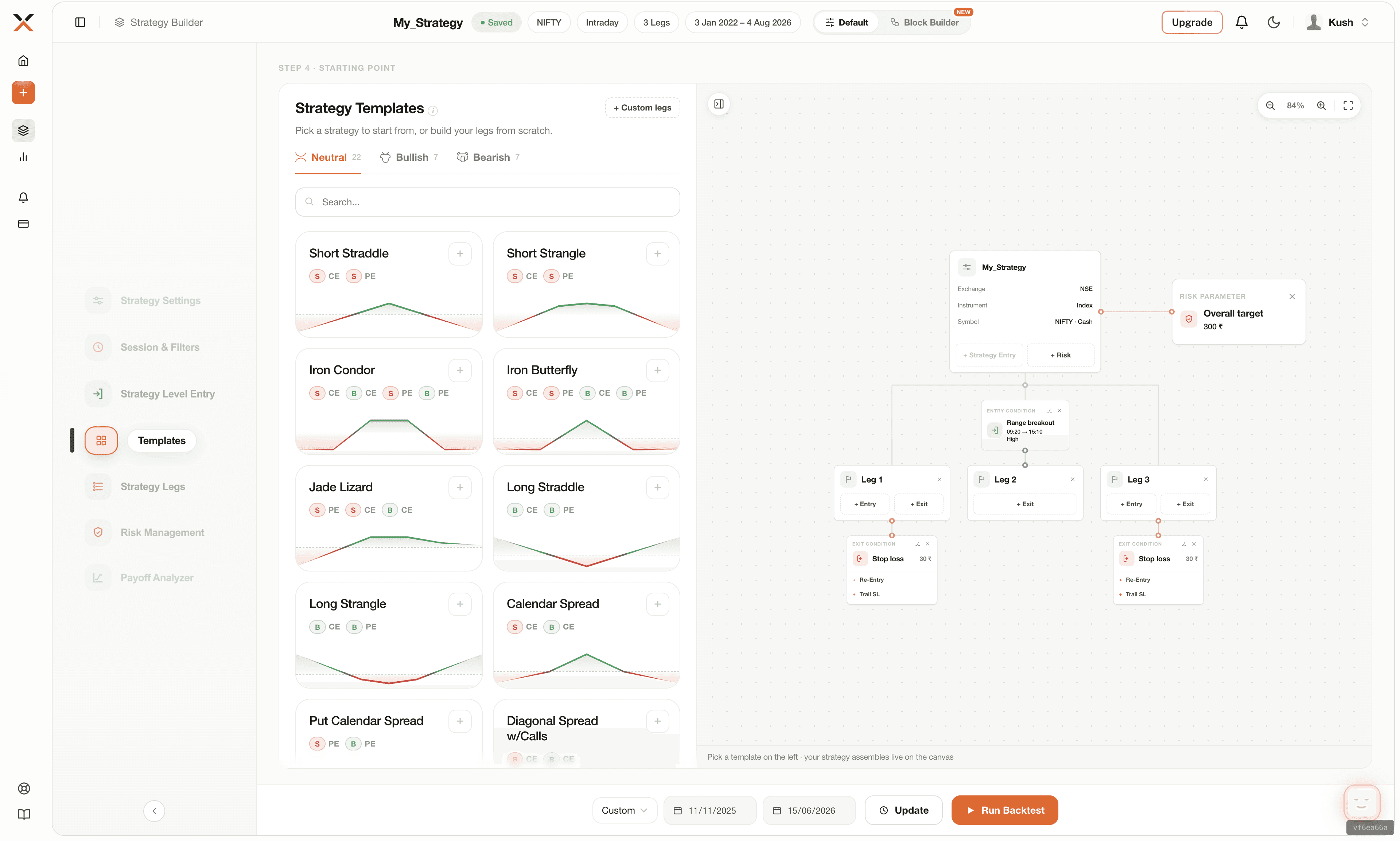
A trader wants to sell an iron condor on NIFTY. He has one rule the old builder could never hold: a single 30-rupee stop loss on both short legs. He names the strategy and picks NIFTY intraday, and the strategy card fills as he types. He picks Iron Condor from one of Zenxo’s 26 templates, and four legs appear side by side, because that’s how they run.
He adds Risk, Stop Loss, 30 rupees, and wires it to both short legs. The node labels itself SHARED WITH 2 LEGS. One leg has nothing beneath it, and the empty + Exit slot is the warning. He fills it and hits Run Backtest. Six steps, a live countdown, then the verdict page opens headline first.
One step at a time
The stepped rail replaced the nine-section scroll. It gives newcomers a linear path, and the nav still lets people jump around if they know what they want. New users work in the form and watch the diagram build itself. By the time they’re ready to work canvas first, they already know how to read it.The default mode teaches the block builder mode, and nobody has to sit through a tour.


Decision 01
More freedom was the version nobody would learn.
Option A: Drag-to-reveal connectors
Expressive, and closer to how node editors work. But it puts a learning curve in front of the thing meant to simplify the product.
Option B: A button on the block itself
Click + Exit and an exit appears. Less elegant, zero discovery cost.
Chosen: B
Every leg carries its own + Entry and + Exit button, so the next move sits on the thing it applies to. The interface teaches itself as you use it.
The empty + Exit slot doubles as the affordance and the warning.


Decision 02
A form can list settings. It can’t show relationships.
Option A: Form + grouping checkboxes
Cheapest to build, and it’s what every competitor ships. But close the panel and the relationship vanishes.
Option B: A canvas of nodes and wires
A shared rule becomes a permanent shape. Costs a new interaction model, and a much harder build.
Chosen: B, on a split screen
Changing one number on a canvas is slow, and traders optimise for speed. So the form stayed default, the canvas its live mirror. It can’t drift from the form, because it is the form. Narrow was the harder sell: a wide form makes the eye travel, and every trip costs time. That “wasted” space is what lets the canvas sit beside it. I pushed back, and held.
The founder agreed. The split screen is the product’s defining layout, and you see the structure while you build it.

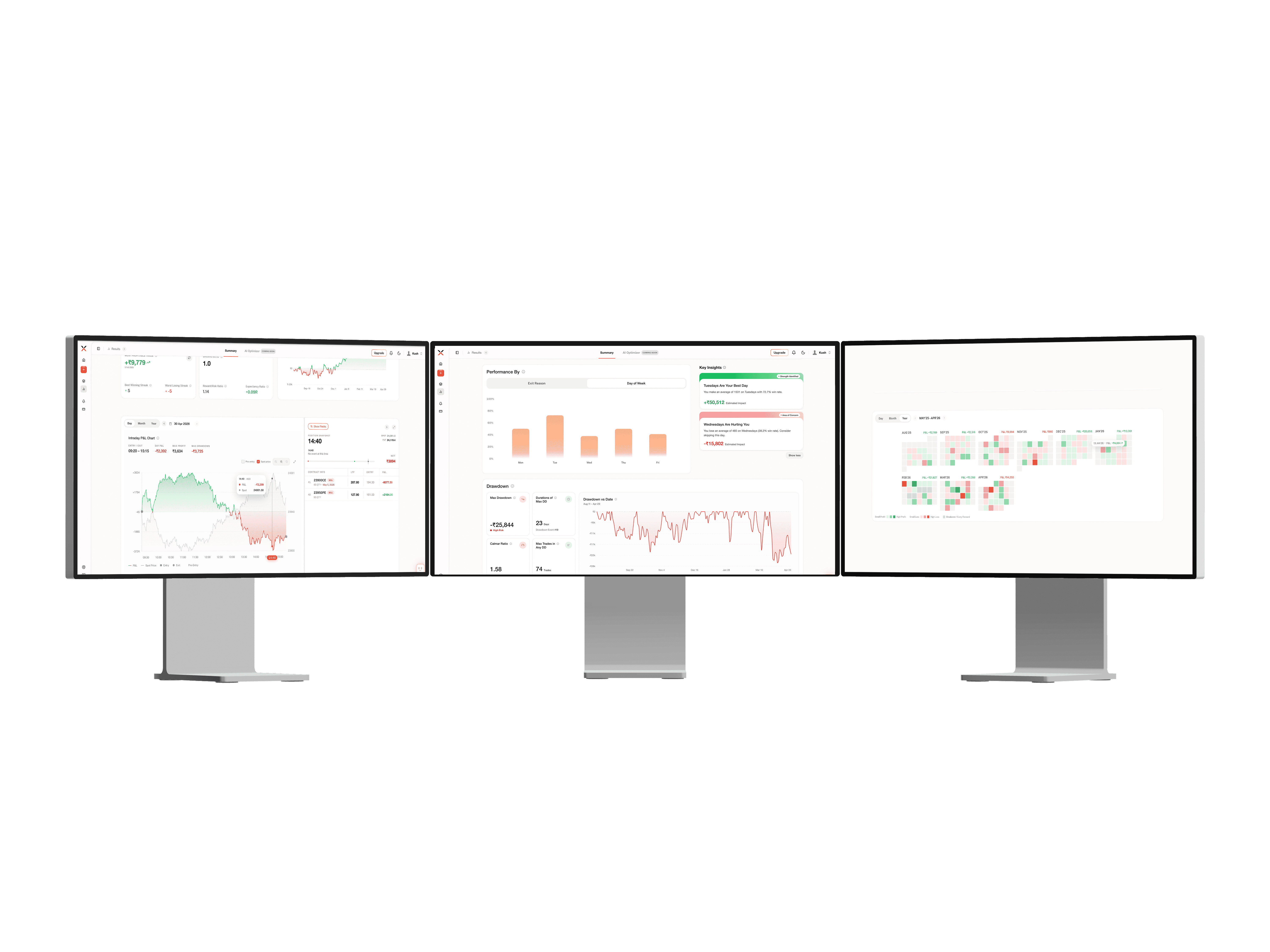
Backtesting Results Page as a descending funnel
The headline verdict comes first, then shape over time, then patterns, then the raw evidence. The reader picks how deep to go. Exit reasons are broken out by type, and insights are labelled by their coloured tab before you read a word.
The data shown is demo data. The backtesting engine is the backend team’s work. The hierarchy and the honesty of the page are mine.

PROBLEM
Twenty-one panels deep, still guessing.
Every card had the same border, the same padding, the same importance. Your net profit sat in a tile the size of your worst losing streak. Scroll far enough down and a pink box said the strategy would lose money over time, in the same treatment as everything above it.
trader opens a backtest to answer one question: should I run this.
Nothing decorates
There’s one accent colour, and it’s rationed. Motion reports state. A pulse runs along the wires when a rule is grouped. The assistant has intent instead of jargon. Zenbot builds blocks on the canvas live rather than describing them, across 24 supported brokers. The form and the canvas use the same components because they read the same data.
Orange means “act here” or “you are here,” and nothing else.
The orbiting dots stall when the strategy does.
The greeting and the clock run live off the viewer’s own time.
THEMES
Light and dark
Traders are accustomed more to dark mode so having that was necessary.

What’s next, and what I’d redo
What’s next: overlapping shared rules currently drop to a second row. It’s readable, but it’s the layout at its least elegant. Smaller screens come next. The form column is fixed, so the canvas is the part that has to adapt to different viewport sizes.
One thing I got wrong: I once raised a PR without pulling the latest changes on dev, and it cost the team time. When you design and ship in the same repo, you learn the team’s rhythm before you touch it, not after.